V‑Port Ball Valves: Why They Solve Jamming and Leakage for Particle‑Laden Media | GEKO Valve
Nov 16, 2026
V‑Port Ball Valves: Why They Solve Jamming and Leakage for Particle‑Laden Media
Ball valves are not limited to simple on‑off service. One special variant, known as the V‑port ball valve, features a V‑notch cut on the ball core. It performs reliable shut‑off while delivering precise throttling and flow regulation capabilities. Many engineers encounter recurring jamming, leakage and stiff operation when applying standard O‑port ball valves for particle‑bearing, fibrous media in water treatment, mining and pulp‑and‑paper plants. In most cases, the root cause lies in incorrect valve type selection rather than product quality.
GEKO Valve’s V‑port ball valves are purpose‑built to handle these challenging abrasive process conditions.
What Exactly Is a V‑Port Ball Valve?
A conventional O‑port ball valve has a full‑bore circular opening on its ball, rotating 90° for complete open‑close action with only basic on‑off functionality.
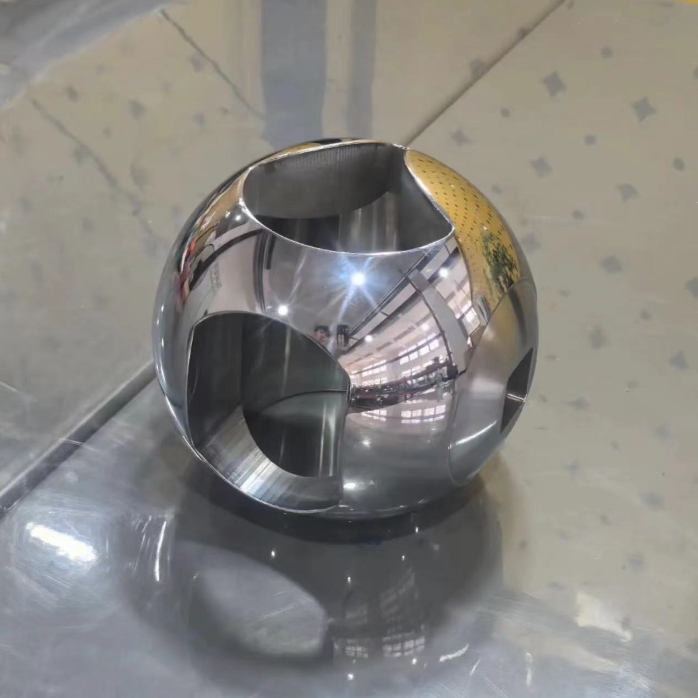
By contrast, the ball of a GEKO V‑port ball valve is precision‑machined with a precise V‑shaped notch.
As the ball rotates, the overlapping area between the V‑notch and valve seat changes following a predefined flow curve, enabling continuous, adjustable flow control. Simply put: a V‑port ball valve combines the tight shut‑off advantages of a ball valve with the modulating performance of a control valve. Most GEKO V‑port configurations deliver equal‑percentage flow characteristics; linear V‑notch profiles are also available upon request. For equal‑percentage characteristics, flow changes moderately at small openings and responds sensitively at larger openings, ideal for stable modulating processes. This differentiates V‑port designs fundamentally from standard O‑port ball valves with quick‑opening flow behaviour.
V‑Port Ball Valve vs O‑Port Ball Valve: Key Differences
The critical advantage comes from the sharp shear edge formed by the V‑notch. During rotation, this cutting edge shears fibres and breaks agglomerated particles off the seating surface, delivering the well‑known “self‑cleaning” effect. Standard O‑port ball valves lack this shear geometry and easily trap impurities between sealing faces.
Comparison Item
O‑Port Ball Valve
GEKO V‑Port Ball Valve
Primary Function
Isolation & on‑off shut‑off
On‑off isolation + flow modulation
Flow Characteristic
Quick‑opening
Equal‑percentage / Linear (customizable notch)
Anti‑clogging Performance
Fair; particles easily become trapped
Excellent; V‑notch provides shear self‑cleaning
Frequent Modulating Service
Not recommended
Well‑suited; compatible with valve positioners
Typical Media
Clean fluids
Particle‑laden, fibrous and viscous media
How Does a GEKO V‑Port Ball Valve Prevent Clogging?
Two common failure modes plague valves handling particle‑rich and viscous fluids: particles wedged between sealing surfaces causing leakage, and scale buildup leading to stiff actuation.
Throughout opening, closing and modulating cycles, the V‑notch continuously scrapes across the seat face to clear deposits and keep sealing surfaces clean. When paired with metal hard‑seated construction with hard‑alloy overlay welding or spraying on sealing faces, GEKO metal‑sealed V‑port ball valves withstand elevated temperature, high differential pressure and abrasive wear for extended service life. Metal‑sealed V‑port ball valves comply with GB/T 21385 standard specifications for metallic‑seated ball valves.
Even so, V‑port ball valves are not universal solutions. They are not the optimal choice for ultra‑pure service, extreme high‑temperature conditions or very low‑differential‑pressure applications, where dedicated valve types should be selected instead.
Main Industrial Applications for GEKO V‑Port Ball Valves
Water & Wastewater Treatment: Return sludge, waste sludge, aeration branch lines and chemical dosing pipelines. Thanks to self‑cleaning performance, GEKO V‑port ball valves resist blockage better than globe valves or butterfly valves for suspension‑bearing water systems.
Mining & Mineral Processing: Tailings slurry, concentrated ore slurry and heavily abrasive particle‑carrying media. Wear‑resistant GEKO V‑port ball valves with hard‑faced sealing surfaces are strongly preferred.
Pulp & Paper Industry: Paper pulp, white liquor and black liquor with high fibre content and viscosity. The shear self‑cleaning geometry effectively prevents fibre entanglement on sealing interfaces.
Hygienic Sanitary V‑Port Ball Valves: Food and pharmaceutical processes. GEKO sanitary V‑port ball valves are available in tri‑clamp or butt‑weld end connections with low‑Ra surface finish, supporting full CIP / SIP cleaning cycles for dairy, beverage and bio‑pharmaceutical metering and dosing pipelines.
Lined V‑Port Ball Valves: Corrosive chemical and pharmaceutical service. Wetted surfaces lined with PFA or F46 fluoropolymer separate metallic components from aggressive media, combining accurate modulation with outstanding chemical resistance.
Five Critical Points for V‑Port Ball Valve Selection
Flow Characteristic: Choose equal‑percentage or linear V‑notch profiles according to your modulating requirements; GEKO supports custom V‑notch angle machining.
Seat Material: Select metal hard‑seats for high‑temperature and abrasive‑wear duties; PTFE soft‑seats deliver tight shut‑off with limited temperature and chemical boundaries.
Nominal Size & Differential Pressure: For large‑size and high‑delta‑pressure conditions, verify sufficient output torque from the actuator.
Actuation Package: For modulating control, specify pneumatic or electric actuators complete with positioners accepting standard 4‑20 mA control signals, fully assembled and tested at GEKO factory.
Media Corrosivity: Specify fluoropolymer‑lined or special alloy constructions for strongly corrosive process fluids.
Relevant industry standards include GB/T 12237 for steel ball valves for petroleum‑petrochemical service, GB/T 4213 for pneumatic control valve actuation and testing, and GB/T 13927 for industrial valve pressure‑testing protocols.
Quick Selection Reference Table
Application Scenario
Recommended GEKO V‑Port Ball Valve Type
Key Reason for Selection
Modulating service with fibrous or particle‑laden media
General‑purpose V‑port ball valve
V‑notch shear self‑cleaning; avoid O‑port ball valves for this duty
High‑abrasion mine tailings and ore slurry
Wear‑resistant hard‑faced V‑port ball valve
Hard‑alloy overlay / sprayed sealing surfaces for anti‑abrasion performance
Food‑pharmaceutical service requiring in‑place cleaning
Sanitary hygienic V‑port ball valve
Tri‑clamp / butt‑weld ends, compatible with CIP & SIP cleaning cycles
Strongly corrosive chemical media
Fluoropolymer‑lined V‑port ball valve
PFA / F46 lining isolates valve body from aggressive process fluids
Conclusion
Integrating reliable shut‑off and accurate throttling within one unit, GEKO V‑port ball valves excel for “dirty, viscous and abrasive” working conditions across water‑wastewater, mining, pulp‑paper, food and pharmaceutical industries. If you face difficulties with specification, share detailed parameters including medium property, operating temperature and differential pressure with GEKO Valve’s engineering team for customised valve recommendations.
EN SAVOIR PLUS






 E-mail
: info@geko-union.com
 E-mail
: info@geko-valves.de
 E-mail
: tw@geko-union.com
 E-mail
: nl@geko-union.com



 Réseau IPv6 pris en charge